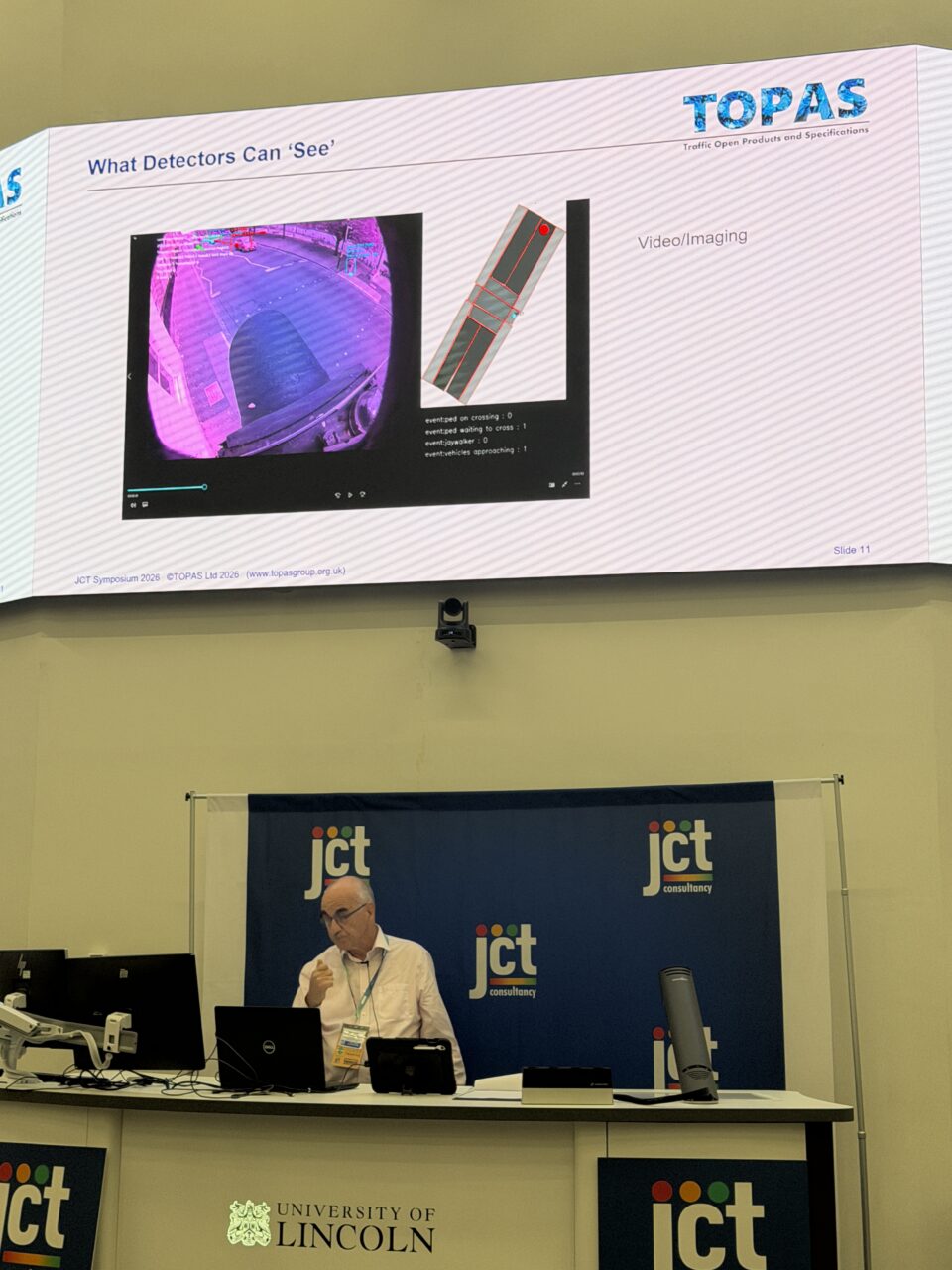
Standards for road network detectors should be based on the information needed to operate the network, rather than an assumption that every device must achieve 100% accuracy, delegates at the JCT Traffic Signals Symposium in Lincoln have heard.
Mark Pleydell, one of the traffic signals sector’s leading experts and a prominent thinker on standards, used his presentation to ask a deceptively simple question: how good is good enough?
Dr Pleydell, director of PTC Ltd and a member of the TOPAS management board, explained how Traffic Open Products and Specifications is developing two standards intended to help authorities procure and use the latest generation of road-based detectors.

The first, TOPAS 2547, will classify detector performance against defined traffic management functions. The second, TOPAS 2545, will provide an open interface through which detectors can send information to traffic signal controllers.
Together, the standards are intended to connect technical performance with the outcomes that traffic engineers need to deliver on real networks.
“Without the eyes and ears on the road, you don’t know what the traffic is doing,” Dr Pleydell told the symposium. “If you don’t know what the traffic is doing, how the hell do you run your network?”
Moving beyond absolute requirements
Existing detector specifications have generally used absolute terms such as “must detect”, “may detect” and “must not detect”. Mark Pleydell argued that these definitions do not necessarily reflect performance in real-world conditions.
Evidence from sites where detector output has been checked against video reviewed by a human observer suggests that many detectors operate at around 80% detection accuracy. Comparisons between technologies can also show both over-counting and under-counting at different times and under different traffic conditions.
This does not necessarily mean that the equipment is unsuitable. A detector does not need to identify every vehicle or road user correctly to supply useful information, provided its performance is sufficient for the particular control function.
The effect of a missed or false detection also varies. Missing one vehicle in a platoon may have relatively little effect if the detector identifies the other vehicles. Missing an emergency vehicle requesting priority, or reporting one that is not present, could have much more serious operational consequences.
The challenge for a useful standard is therefore not to demand perfection, but to establish evidence-based thresholds appropriate to each application.
Standards matched to the task
Draft TOPAS 2547 criteria cover more than 20 uses of detection, including vehicle-actuated control, MOVA, SCOOT, kerbside and on-crossing detection, bus priority, stopped-vehicle detection and emergency vehicle priority.
For each use, the standard is expected to specify the objects that must be detected, the required detection rate, the operating range and the acceptable number of false-positive detections.
The proposed thresholds vary according to the function. Draft requirements commonly specify detection rates of 90% or 95%, while the permitted false-positive rate ranges from 20 per hour for some general traffic applications to 0.05 per hour for emergency vehicle priority.
These figures remain open to discussion, but they illustrate the principle that performance should be proportionate to the consequence of an error.
A product registered as meeting particular TOPAS 2547 classes would have demonstrated that it could support the corresponding traffic control functions when installed and configured in the tested way. A detector might, for example, be registered for vehicle-actuated, kerbside and on-crossing detection from one configuration, while requiring a separate configuration and registration for longer-range functions.
This distinction is important because modern camera, radar and lidar products can monitor several areas and object types simultaneously. A detector positioned to provide a strong view of a crossing may not perform equally well when asked to identify buses around 328ft (100m) from the stop line.
For authorities and designers, the proposed registration system is intended to reduce that complexity to a set of recognised performance classes.
“TOPAS has to be user friendly,” Dr Pleydell said. “That’s what we’re trying to do here. We’ve had to add one layer, but only the one.”
Testing in the real world
TOPAS 2547 is also expected to define how detector performance must be tested. A short trial in favourable weather would not provide sufficient evidence, so the proposed method calls for testing over about six weeks, across day and night, different weather conditions and statistically meaningful numbers of each required object type.
Testing would take place at sites meeting common criteria, including straight and relatively level approaches, representative pedestrian facilities and typical detector mounting positions. Mark Pleydell identified two sites on Newark Road in Lincoln as potential examples.
A separate reference system would establish a ground-truth dataset against which the product’s detection and false-positive rates could be assessed. The detector’s mounting position, orientation and configuration would also be recorded, ensuring that the claimed performance relates to a reproducible installation.
“We’ve got to start with something in the messy analog real world,” Dr Pleydell said. “And this is where we start from.”Dr
Getting useful data to the controller
Establishing how well a detector performs addresses only part of the problem. Its information must also reach the traffic signal controller in a usable and timely form.
The present TOPAS 2523 interface essentially provides a binary indication of whether an object is present in a detection zone. Modern detectors can produce much richer information, including an object’s type, location, direction, speed, acceleration and the device’s confidence in its classification.
TOPAS 2545 is being developed to convey that information through a common detector-to-controller interface. It is intended to support existing cabling where practicable, reduce the need for manufacturer-specific integrations and allow products with the same performance classes to be exchanged more readily.
The interface would also allow a detector to report its own condition. Falling detection confidence or a reduction in effective range could, for example, indicate that a camera window needs cleaning before the device fails completely.
A desktop assessment has been completed and work is under way to test the proposed interface at Cabot Lane in Poole. The field trial is expected to examine the communications link and the changes required within controllers to consume the data.
The two standards consequently address complementary questions: whether a detector can produce information of sufficient quality for a defined task, and whether it can communicate that information in a standard form.
TOPAS’s approach recognises that good performance does not always mean perfect performance. It means understanding the output a traffic control function needs, setting an appropriate threshold and demonstrating through repeatable real-world testing that a product can meet it.
(Picture – JCT)