A project combining established traffic engineering techniques with new technology to unlock around 20% more capacity at junctions in Huntingdon has won Best Paper at the 2026 JCT Traffic Signals Symposium.
“Old Tricks, New Dogs: Improving capacity using old techniques and new tech”, presented by Chris Kennett of Chris Kennett Consulting and Mark Underhill of Cambridgeshire County Council, took the event’s top paper award.
The project used £81,803 of Green Light Fund money to improve eight junctions and two crossings on the western side of Huntingdon, where congestion, exit blocking and changing traffic patterns had been causing problems.
Rather than replace complete installations, the team reviewed the existing sites and used techniques including revised staging and phasing, changes to critical phase orders and improved coordination between junctions. These were combined with MOVA upgrades, above-ground detection, SCOOT, 4G communications and IP-based links between controllers.
The paper reported shorter queues, reduced journey times and congestion beginning later and ending earlier. Active travel was also incorporated through volumetric detection which can extend crossing times when larger numbers of pedestrians and cyclists are present.
It concluded that the relatively modest investment had released around 20% additional capacity while reducing delays, stops and associated carbon emissions.
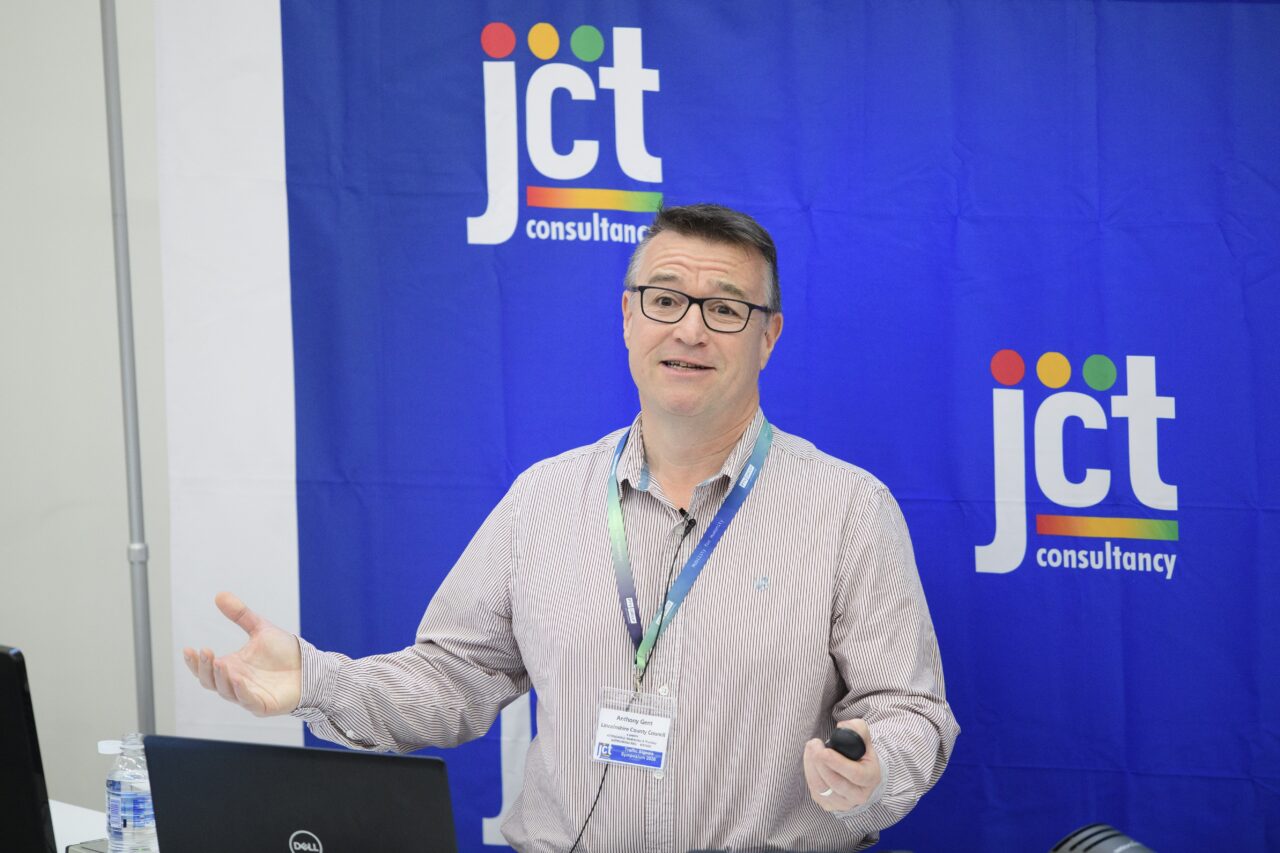
The award for Best Presentation went to Anthony Gent, Principal Engineer for Traffic Signals at Lincolnshire County Council (pictured), for his address on asset management and local government budgetary pressures.
Mr Gent explained how Lincolnshire’s signals estate had grown by 8% in five years without a corresponding budget increase, while 34% of its sites were already more than 15 years old. Its previous approach would have resulted in signals being an average of 28 years old when refurbished.
The council has responded by reducing the scope of refurbishments so the signals budget concentrates on equipment directly linked to their operation. It has also introduced “easy win” upgrades, replacing obsolete equipment at around a third of the cost of a full refurbishment.
These changes are forecast to reduce the average age of sites at refurbishment from 28 to 22 years and cut the proportion more than 15 years old from 33% to 21%.
The Most Pragmatic Paper award went to Daniel Ellis of Barnsley Metropolitan Borough Council and Nick Rule of Yunex Traffic for their presentation on AI-enhanced traffic management using awareAI.
Their paper detailed two targeted applications of AI-based detection. At a school crossing in Penistone, the system identifies periods of high pedestrian demand and provides additional green time while retaining shorter timings when fewer people are waiting.
At Peel Square in Barnsley town centre, the technology distinguishes vehicles from pedestrians around an access-control bollard. This eliminated false calls previously caused by pedestrians being detected by radar, without requiring intrusive work in the high-quality paved public realm.
Peter Routledge of Ian Routledge Consultancy received the Most Technically Inciteful Paper award for an update on the Digital Controller Interface Standard.
The Department for Transport-backed DCIS project is addressing the lack of common UK formats for describing signal-controlled sites, their layouts, controller configurations and live operating data.
Its four elements comprise the Intersection Site Directory, MAPEM topographical files, standardised E2500 controller-configuration files and DCAG data describing the real-time status of controller variables.
While the long-term aim is to support connected and autonomous transport, the paper highlighted more immediate benefits including faster and more accurate network modelling, improved optimisation and easier access to consistently structured traffic signal data.
The awards were announced at the conclusion of the two-day JCT Traffic Signals Symposium at the University of Lincoln. Nearly 200 industry professionals attended, and heard that next year’s event will also be in Lincoln, on 8 and 9 September, with the MOVA Users Group the day before, and will once again include an exhibition after that aspect was paused for this year’s event.
(Picture – JCT)