
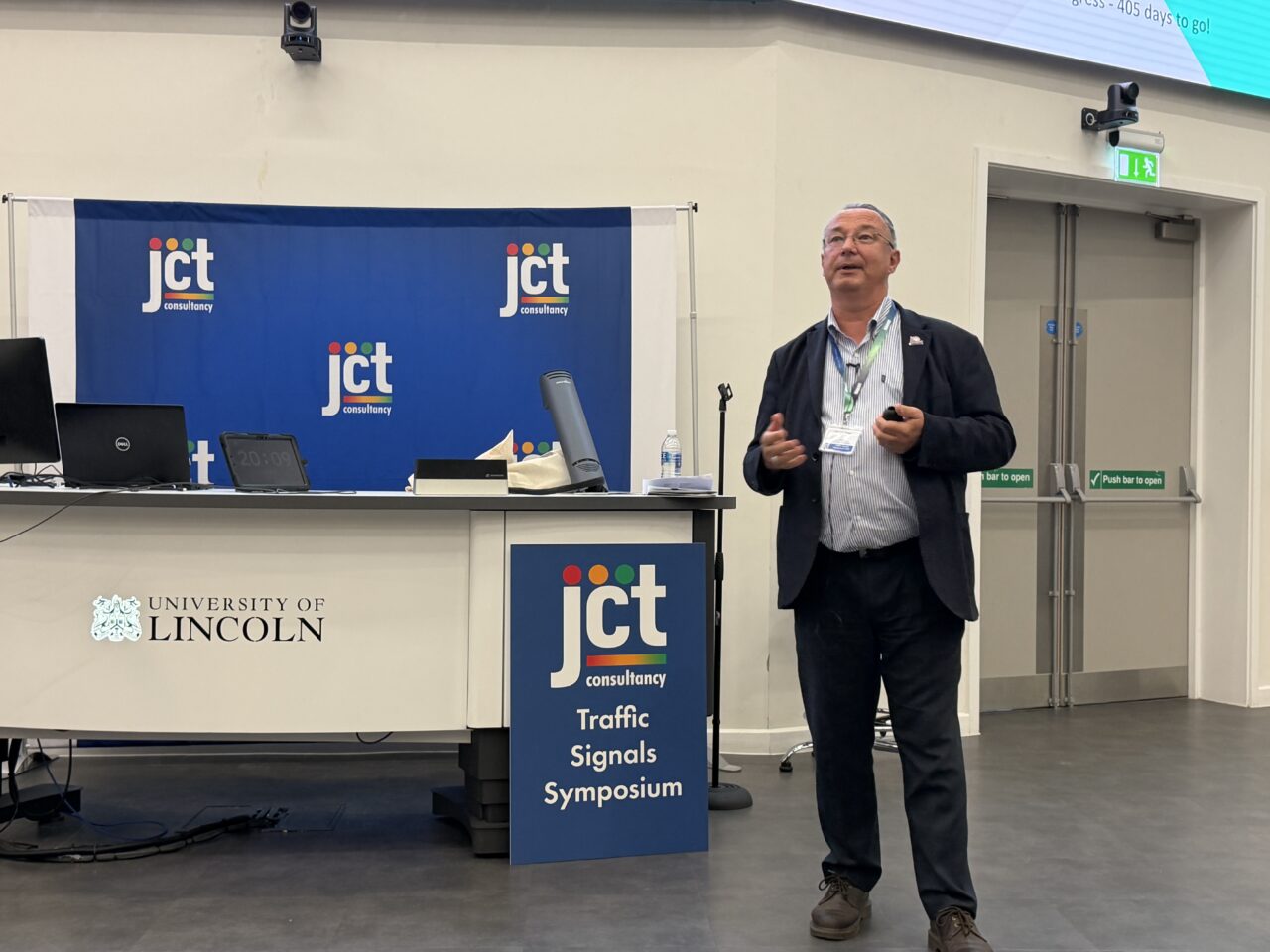
The Department for Transport’s Head of Road Infrastructure Technology has stated his view that the growing interaction between roads, vehicles and digital technology will fundamentally change how the UK manages its transport networks,
Speaking at the JCT Traffic Signals Symposium in Lincoln, Darren Capes suggested authorities and suppliers would need to understand how infrastructure and vehicles exchange data as technology becomes central to improving safety, reducing congestion and supporting economic growth, as he contrasted today’s increasingly connected environment with the beginning of his career.
“When I started thinking about road design back in 1987, the interface between a vehicle and a road was four patches of rubber – that’s it,” he said. “To be honest, you could have been quite a successful road designer if you’d never actually seen a vehicle.
“That’s not the case now. As we move into a world where we have more data and more connectivity, it absolutely is the case that infrastructure will need to know more about what vehicles do, what data they generate and how to interact with vehicles – and vehicles will need to know much more about the infrastructure.”
Mr Capes said services including Waze, Google Maps and eCall already demonstrate this connection, but much current activity remains proprietary or fragmented. The next challenge is therefore to create open and scalable architectures through which information can move predictably between vehicles and infrastructure.
He explained that the Department’s Connected Vehicle Services programme is intended to define, in straightforward terms, the services road users and operators should expect from this data. These could support route guidance, road safety, accessibility and a better understanding of network conditions.
The resulting framework will help identify the standards and guidance needed for data to flow in both directions, as well as gaps requiring government intervention or potentially legislation. It is also expected to give technology companies a clearer picture of the services public bodies are likely to procure in future.
Mr Capes linked this work to the Manual for Smart Streets, the Transport Technology Forum’s online resource designed to guide authorities through the complete technology lifecycle, from considering the outcomes they want to achieve through specification, procurement, operation and maintenance.
He set out the ambition for the manual to provide for digital infrastructure the type of structured guidance already available for the design and management of physical highways.
Work is also beginning to update UTMC, which was originally developed more than 30 years ago to enable roadside equipment and central systems to communicate using open internet protocols.
Rather than needing to create new technical standards from scratch, Mr Capes said today’s problem is the number of different standards and methods available. Updated UTMC guidance will therefore help organisations select consistent approaches so locally developed services can subsequently be connected, expanded and made interoperable.
“This is not about mandating what you do and how you do it,” he explained. “It is about trying to guide us to do it in consistent ways, so a system developed in one city, locality or region can be linked.”
The Department is also rewriting the Code of Practice for roadside electrical equipment. The existing guidance was produced in around 2010 and no longer reflects the technology now deployed across the network. The revised document will provide more relevant maintenance guidance, particularly for authorities where specialist technical resources have reduced.
Delegates will be invited to comment on the new Code of Practice, with Mr Capes stressing that its effectiveness will depend upon input from practitioners responsible for operating and maintaining equipment.
(Picture – JCT)