
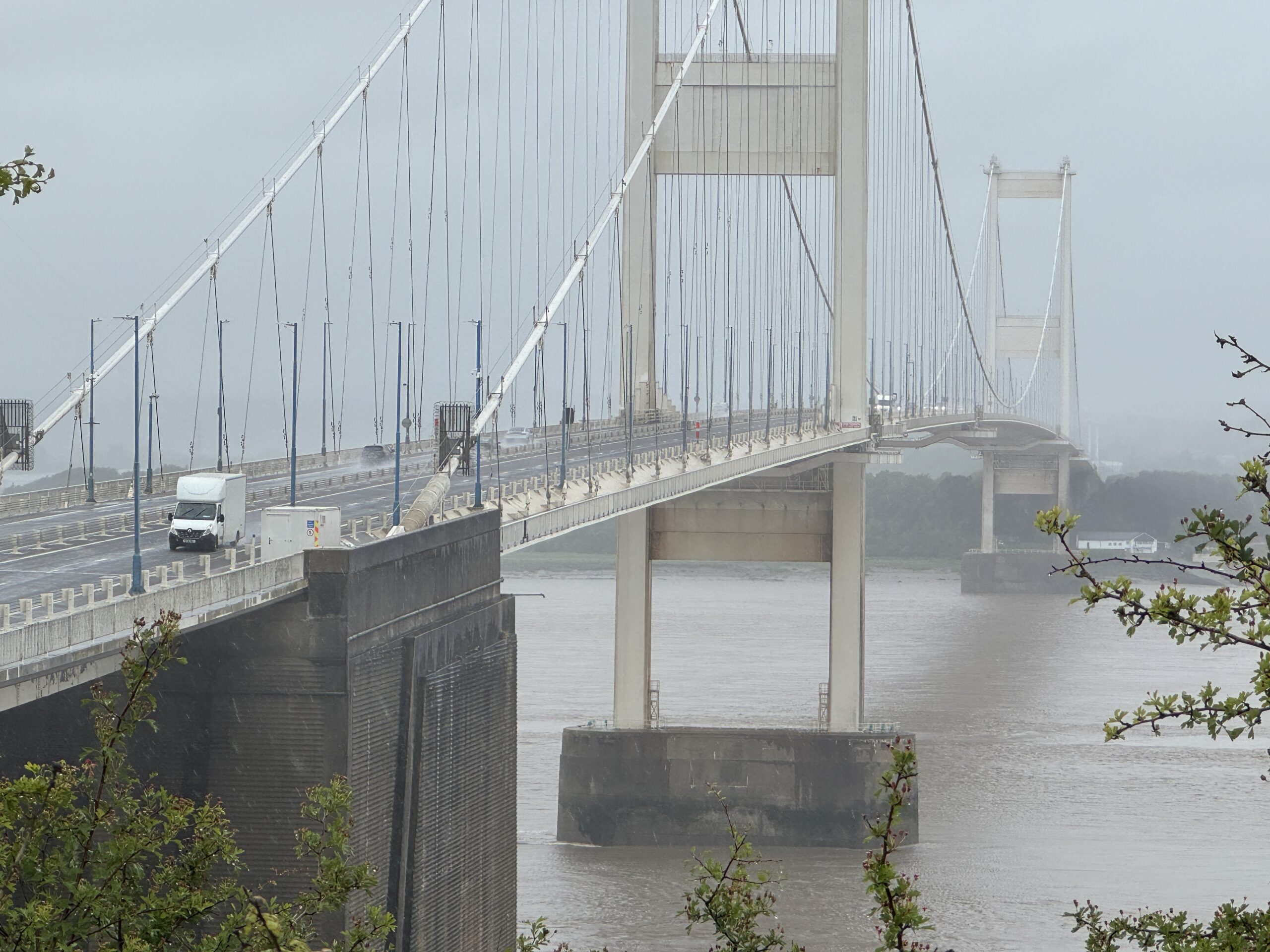
Yesterday marked the 60th anniversary of the opening of the Severn Bridge, one of the South West’s most iconic landmarks.
Opened on 8 September 1966, the bridge transformed travel between England and Wales, strengthening connections for communities, businesses and visitors on both sides of the Severn. For six decades it has been part of the daily lives of millions of people and remains an enduring symbol of engineering innovation and regional connectivity.
Queen Elizabeth II officially opened the crossing on 8 September 1966, after around three and a half years of construction. The bridge formed part of the M4 corridor and connected the motorway network at Aust in Gloucestershire with the road network around Chepstow.

The principal structure is a 1,600m-long suspension bridge, with a 988m main span between its two towers and 305m side spans. Its aerodynamic steel box-girder deck was an important innovation: the streamlined cross-section was developed following extensive wind-tunnel testing to cope with the exposed estuary environment.
Another unusual feature was the arrangement of the suspension cables. Rather than conventional vertical suspenders, the Severn Bridge used a distinctive zig-zag configuration designed to reduce vibration. Stockbridge dampers were also incorporated to control wind-induced oscillations.
The bridge was designed by Mott, Hay & Anderson and Freeman Fox & Partners. Work on the substructure began in March 1961, with John Howard & Co responsible for the foundations. Associated Bridge Builders Ltd constructed the superstructure, while the Wye Bridge and Beachley Viaduct formed part of the wider crossing scheme. Much of the steelwork was fabricated at Chepstow before being transported by water to the construction site.
The main bridge cost about £8 million to build, although the complete crossing project, including the Wye Bridge, viaducts and approach roads, was considerably more expensive. The original crossing was funded by the Government and the cost was intended to be recovered through tolls.
The traffic forecast did not remain valid for long. The crossing repeatedly operated above capacity, prompting the Government in 1986 to announce plans for a second crossing. That structure, now the M4 Prince of Wales Bridge, opened in 1996, three decades after the original.
The first Severn Bridge itself became part of the M48 when the new crossing opened.
Tolls finally disappeared from both crossings in December 2018, ending more than half a century of charging for the journey.
For today’s traffic engineers, the anniversary is a reminder not only of a striking piece of 1960s bridge engineering, but also of a familiar transport lesson: infrastructure designed to solve one generation’s capacity problem can become the constraint for the next.
(Picture: Paul Hutton)