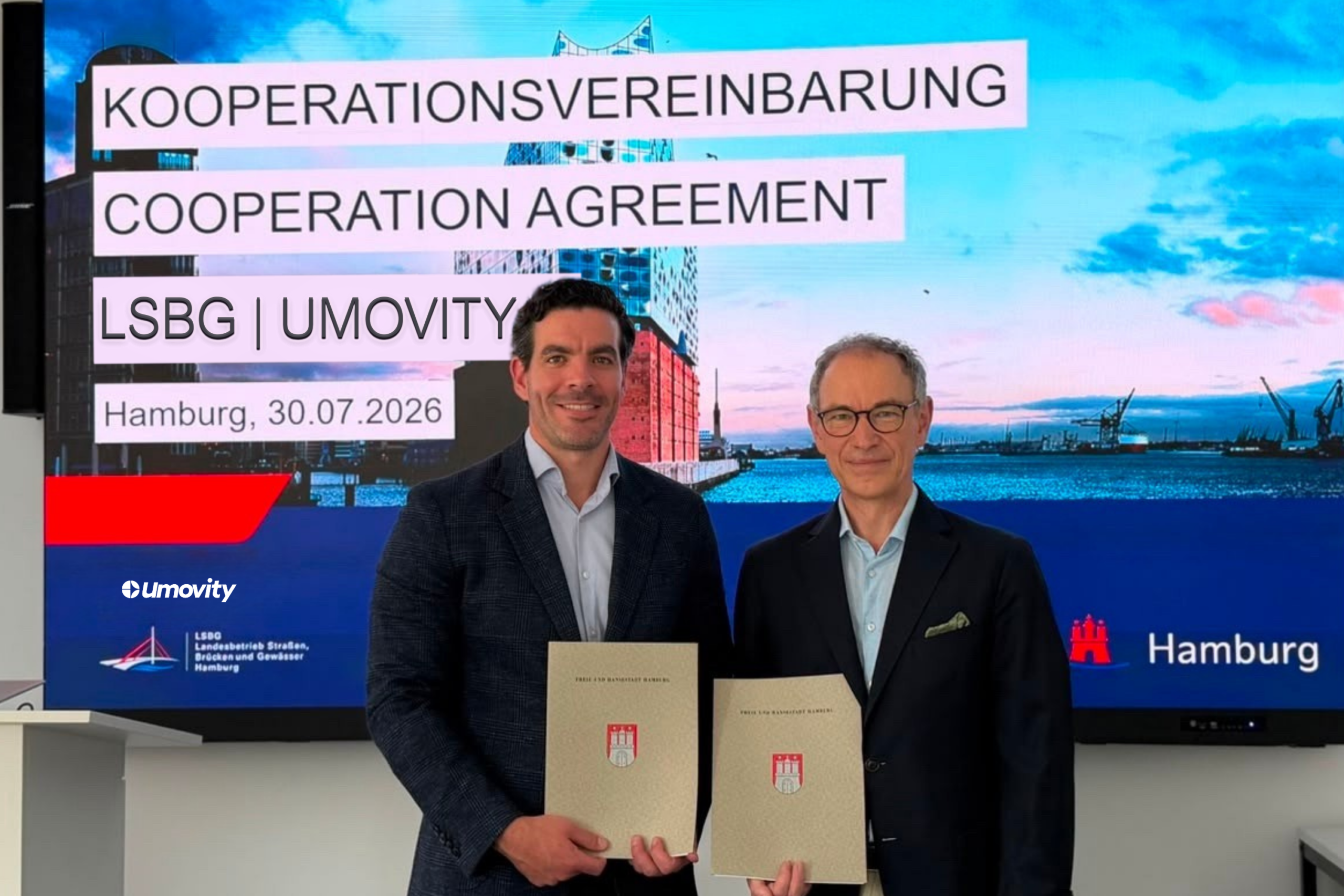
Umovity and the State Authority for Roads, Bridges and Waterways (LSBG) of the Free and Hanseatic City of Hamburg have signed a partnership agreement to develop the next generation of adaptive, network-wide traffic signal control. As part of the PULS – Progressive Urban Traffic Management and Control Systems project, the partners will create a cloud-based, AI-powered solution that optimizes traffic in real time and supports Hamburg’s transition towards intelligent, network-wide traffic management. The agreement was signed by Christoph Heel, Chief Digital Officer at LSBG, and Nick Ghia, CEO of Umovity Software by PTV Group (pictured).
As one of Germany’s largest metropolitan areas, Hamburg has long been at the forefront of innovation in urban mobility, combining ambitious sustainability goals with a strong commitment to digitalization. With the PULS project, the city is now modernizing its traffic signal infrastructure by introducing adaptive technologies that can respond dynamically to changing traffic conditions.
At the heart of the partnership between LSBG and Umovity is the development of a cloud-based, adaptive traffic signal control system powered by real-time data. The project marks an important step away from the predefined, rule-based signal control that is still common practice in Hamburg and across Germany. Instead, the new system will continuously learn from traffic conditions, automatically adapt its control strategies and optimize traffic flow across the network in real time.

The new control methods are designed to improve traffic flow throughout the city, with a particular focus on reducing delays and giving greater priority to public transport. By accelerating bus services and reducing travel times, the system will help make public transport more attractive while also contributing to lower emissions through smoother traffic operations. AI-assisted optimization will significantly reduce the manual effort required to develop and maintain traffic signal programs, enabling Hamburg to optimize intersections across the city faster and more efficiently using existing resources.
This new approach is made possible by combining the complementary technologies of PTV Group and Econolite under the Umovity brand. Together, the partners will develop, tailor, and optimize next-generation adaptive control strategies. The solution builds on Econolite’s proven traffic management technology. As part of the project, Econolite’s Centracs® Mobility traffic management platform will be deployed in Europe for the first time. PTV Group is responsible for developing, evaluating, and ensuring the data security of the results. In addition, its traffic simulation tools are used to model and assess the impact of new traffic control strategies on traffic flow across Hamburg.
A key element of the partnership is the establishment of a real-world pilot environment comprising multiple signalized intersections. Here, the newly developed control strategies will be validated under live traffic conditions and assessed from operational, technical and organizational perspectives. The findings will provide the foundation for a potential rollout across Hamburg’s entire traffic signal network.
Christoph Heel said:
“With PULS, we are turning digital transformation into reality. We are creating the technological foundation for connected, data-driven traffic signal control in Hamburg. AI helps optimize traffic by supporting better, faster decisions and continuously improving traffic flow. Through this project, we are investing in a high-performing, resilient and future-ready mobility system.”
Nick Ghia commented:
“Hamburg has consistently demonstrated its commitment to innovation in urban mobility. Together with LSBG, we’re taking the next step towards a traffic signal system that continuously adapts to changing conditions, improves traffic flow and gives greater priority to public transport. By bringing together Econolite’s signal control technology and PTV’s simulation expertise under the Umovity brand, we’re creating a powerful foundation for the future of urban traffic management.”
(Picture: Umovity)