The global intelligent transport systems sector does not have an innovation problem. It has a deployment problem.
Across Europe, Australia and parts of Asia, there is no shortage of trials exploring connected vehicles, automation and data-driven traffic management. What is often missing is the transition from controlled pilots to repeatable, scaled deployment on real-world networks. A recent ITS Australia study tour to Japan offered a practical view of what happens when that transition is prioritised – not as a technical milestone, but as a coordinated systems challenge.
One of the clearest observations from Japan is that many technologies still framed as “emerging” elsewhere are already operating in live environments. The distinction is important: Japan has moved beyond testing individual technologies to focusing on how they function together as part of an integrated road system. The study tour reflected this approach. Delegates engaged not just with technology providers, but with operators, government agencies and research institutions, gaining insight into how systems are governed and run in practice.
In many countries, pilot programs remain disconnected from the institutional and operational frameworks needed to scale. Japan’s model suggests the key is not the technology itself, but how it’s embedded into infrastructure, policy and day-to-day operations.
ITS deployment in Japan is not driven by a single organisation. It reflects collaboration between national government, infrastructure operators, automotive manufacturers and technology providers. This enables alignment across policy, investment and operational delivery. An alignment often missing in more fragmented jurisdictions.
For countries such as the UK and Australia, this coordination gap remains a major barrier to scaling emerging ITS solutions. The technical capability is there, but institutional alignment lags. For now, at least.

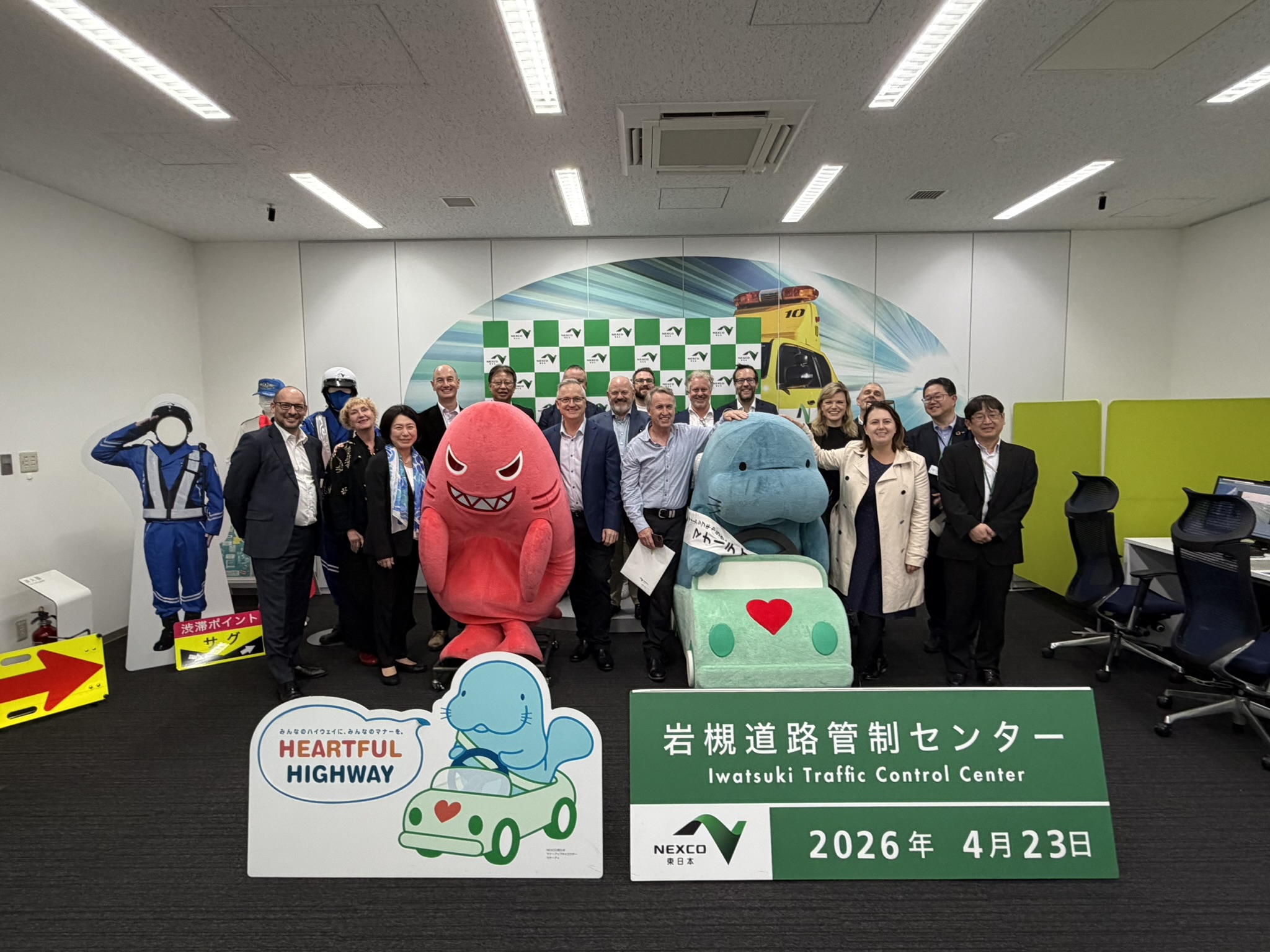
Another key takeaway is the central role of operations. ITS is often discussed in terms of vehicles, sensors or platforms. However, the Japanese experience highlights that outcomes are delivered through the operational layer – traffic control centres, network management systems and real-time decision-making. Exposure to control environments and live network management demonstrated how data, infrastructure and vehicles are brought together in practice to manage congestion, incidents and network performance.
This reinforces a simple point: without an operational framework capable of integrating and acting on data, even advanced ITS technologies struggle to deliver consistent results.
Japan’s approach also broadens the definition of ITS beyond mobility and efficiency to include resilience. Transport systems are being designed to withstand and respond to disruptions such as earthquakes, floods and fires. In this context, ITS becomes a tool not just for managing traffic, but for maintaining continuity of critical infrastructure. Data plays a central role. Rather than being treated as a by-product, it is positioned as infrastructure in its own right – supporting planning, operations and long-term optimisation. For countries facing increasing climate pressures and network complexity, this shift in thinking is likely to become more important.
While Japan’s transport ecosystem has its own characteristics, several lessons are broadly transferable. Moving from pilot to deployment requires alignment across policy, infrastructure, operations and industry stakeholders. Operational capability matters as much as technological capability. Institutional coordination is critical to scaling beyond isolated trials. And resilience needs to be embedded into ITS planning from the outset, not treated as a secondary consideration.
These lessons resonate across the UK, Europe and Australia, where innovation often moves faster than implementation. The core technologies – connected vehicles, automation and AI-driven analytics – are reaching maturity. The challenge is no longer proving they can work but demonstrating how they can be deployed at scale in complex, real-world environments.
Study tours like the ones ITS Australia offer its members help bridge gaps between global peers to share practical lessons on deployment. Through initiatives like the Japan study tour and embassy roundtables, industry and government can come together to exchange real-world insights on what enables systems to scale. While Australia has led in deploying new transport technologies, the tour underscored the value of learning from Japan’s integrated, operational approach.
Japan’s experience suggests that progress does not depend on a single breakthrough, but on the careful integration of multiple systems supported by coordinated policy and operational frameworks. In that sense, the next frontier for ITS is not innovation – it is implementation.
And that may be the most difficult step of all.

You can read the full Study Tour report HERE.
(Pictures: ITS Australia)