
Department for Transport (DfT) data analysed by Select Car Leasing ahead of Road Safety Week (15-21 November) has suggested that almost 28,000 young pedestrians aged 18 and under were injured or killed in collisions across the past five years. Of these, nearly half (12,964) were injured while attempting to cross a carriageway not near a crossing.
Meanwhile, more than 4,700 were injured while at a pedestrian crossing – a sixth of the overall number of casualties.
The figures also highlight that autumn – and specifically November – is consistently the most dangerous period for young Britons. Between 2021 and 2025, November recorded the most casualties of any month (2,757). This is 80 percent higher than the lowest month, August (1,532).

Graham Conway, Managing Director at Select Car Leasing, said:
“One in six accidents involving young pedestrians take place at a designated crossing.
“That’s a significant figure and one that highlights the extreme need for caution – for both drivers and pedestrians alike. This is an issue we’ve highlighted before, as we reported on a recent rise in motorists being prosecuted for pedestrian crossing-related offences.
“With thousands of drivers guilty of breaching crossing rules each year, it’s paramount that pedestrians take measures to protect themselves. Parents should also remind youngsters about the potential dangers. No matter the type of crossing, never step into the road and expect traffic to stop for you.
“You can’t assume that a driver has seen you; they may not be able to stop in time, and they may not have even registered a red light. It’s not an exaggeration to say that taking a cautious approach at pedestrian crossings could be the difference between life and death.”
During the five-year period analysed, 136 young pedestrians lost their lives. More than 7,300 suffered ‘serious injuries’ while around 20,000 sustained ‘slight injuries’.
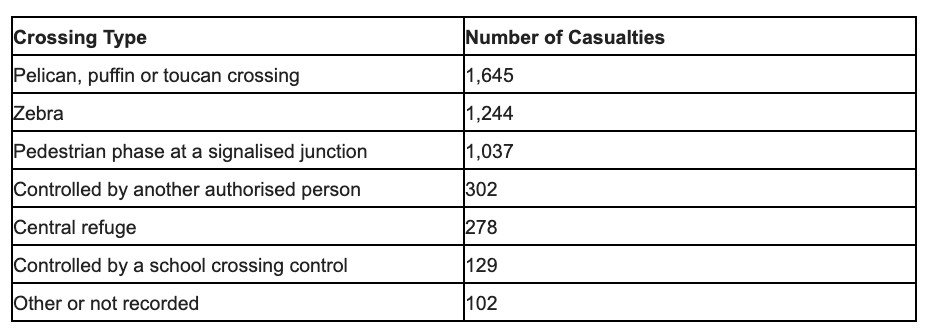
Crossing types with the highest casualties
The data shows that between 2021 and 2025, 4,737 pedestrians aged 18 and under were injured or killed while on a pedestrian crossing.
The severity of injuries increases sharply with the speed limit.
A majority of casualties occurred on roads with a speed limit of 30mph (20,151) followed by roads with a 20mph speed limit (6,070).
Seventy-four percent of casualties on roads with a speed limit of 30mph or lower are classified as slight.
While the number of casualties drops significantly with higher speed limits, the share of young pedestrians killed or seriously injured increases dramatically.
There were 127 reported casualties on roads with a 50mph speed limit, while roads with a speed limit of 60mph and 70mph account for 264 and 56 casualties, respectively.
On roads with a speed limit of 70mph, 68 percent of casualties resulted in the young pedestrian being seriously injured or killed.
This study analysed the Department for Transport’s (DfT) road casualty and collision records for Great Britain from 2021 to 2025. Casualty records were filtered to pedestrians aged 0–18 inclusive, then matched to collision records using the collision_index field to establish the date and time of each incident.
The analysis covers 27,746 pedestrian casualties. Each casualty was counted once, meaning a collision involving two pedestrians aged 18 and under contributes two casualties. Monthly figures are based on the date of the collision. The five-year monthly ranking uses total recorded casualties.
(Picture: Yay Images)